

Paperback tales from inside higher education
Bad education, secret lecturers and a lost king
Hello to all. Apologies for the recent period of silence here on BBWBR.
I’m very excited to be able to announce that, for the first time, my book Our Teaching’s Great, The Admin Sucks: Tales from Inside Higher Education is available in paperback.
Getting to this point is at least one reason why activity here has been slow of late. The rights reverted to me in August and I had underestimated the amount of extra work (I won’t say ‘admin’…) involved in putting it out myself.
I’m pretty happy with how it’s turned out, and am delighted to finally be able to hold a physical book in my hands. If you don’t own it already, then I do hope you’ll consider buying a copy. (It’s available in eBook format, too, at a new, lower price).
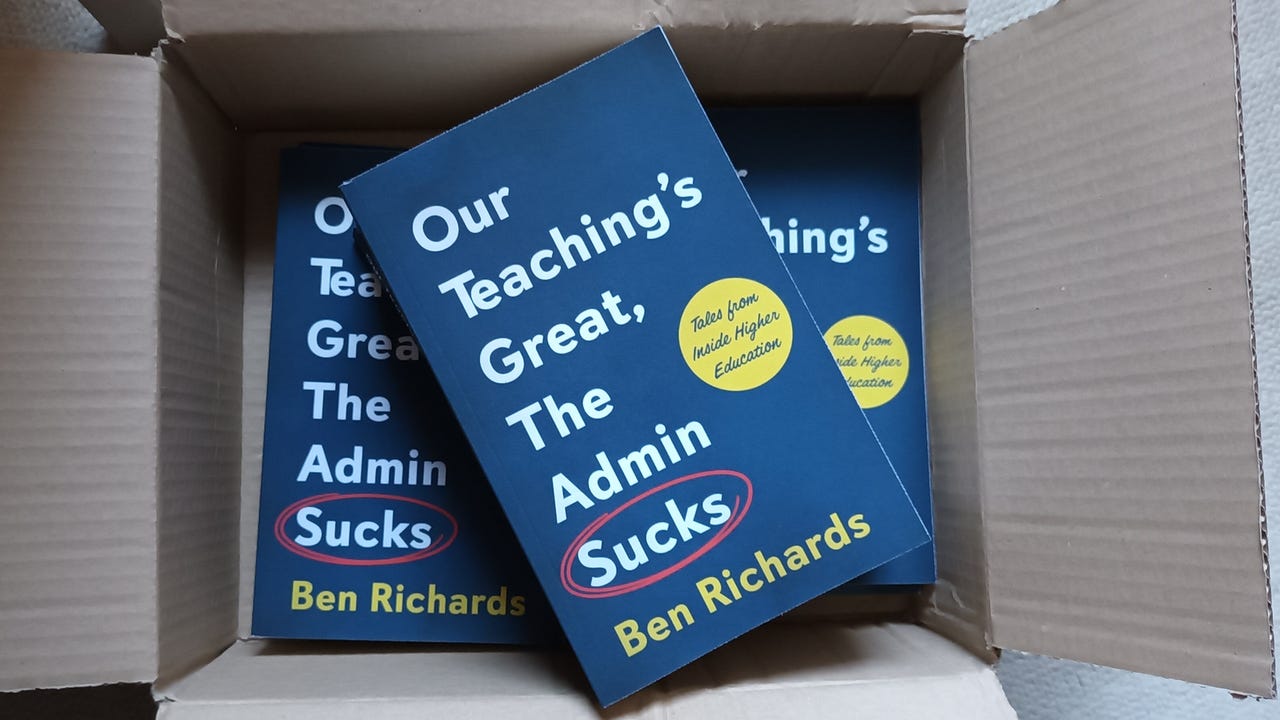
A lot has happened since Our Teaching’s Great, The Admin Sucks was first published, and though I decided not to try and add any updated material for this release, I have added a new introduction to acknowledge that it tells a tale of a certain time, when everyone hated a Tory government rather than a Labour one (remember that? It seems so long ago…)
When the book came out, I wasn’t really aware of anything else out there offering a behind the scenes account of higher education in the UK. That’s changed a bit over the last couple of years, with the release of The Secret Lecturer: What Really Goes on at University and Bad Education: Why Our Universities Are Broken and How We Can Fix Them.
I did briefly consider reading these books and comparing the authors’ experiences with my own, but eventually decided against it on the basis that I find returning to that world quite depressing, and I spent quite enough time listening to academics complaining about things when I was receiving a salary in exchange.
They could both, of course, be very good, although I note that the author of Bad Education, Matt Goodwin, is apparently one of those chaps who complains about being cancelled (among other things) in multiple TV appearances and a book published by Penguin, and perhaps even just looking him up may have altered my Amazon and Google algorithms in potentially troubling ways.
As for The Secret Lecturer, no doubt conceived as a This Is Going To Hurt for the higher education sector, I’m not aware of it quite ever breaking through into mainstream discussion, probably because — obvious point alert — more people are more concerned about the NHS1 and their health than whatever is going on in universities, and as such it mainly attracted reviews from inside the sector.
I do try to avoid such things, for the same reasons noted above, although I still can’t help clicking on them if I see them.2
One story that did interest me was the news that Steve Coogan’s Baby Cow productions had settled out of court with Richard Taylor, the former deputy registrar of the University of Leicester, over his portrayal in The Lost King.
The film highlights the role of an amateur archaeologist, Philippa Langley, in unearthing the remains of Richard III and her subsequent sidelining by the university, which claimed credit for the discovery.
It’s been a while since I saw The Lost King, but my memory is that its portrayals of academic attitudes and the corporate machinations of a university were spot on. At the time, part of me was interested to see if the film, or even coverage of the subsequent legal battle, might help to shine a light on these less savoury aspects of higher education and bring them to the attention of the wider public.
However, despite both receiving some press attention and Coogan penning a spiky non-apology following the settlement3 it was hardly a major news splash, with some journalists evidencing their lack of interest in the specifics by referring to Taylor as an academic. (Whatever his qualifications, the role of deputy registrar is an administrative one).
In one sense these things matter little, really, as the general point — knobby behaviour, as depicted in the film, is endemic in higher education — still stands. Certainly, it isn’t restricted to one particular institution or individual, and I can understand why any one such institution or individual would be more than slightly miffed at being singled out in such a way.4
Anyway, regardless of the recently published works of secret lecturers and cancelled/not cancelled professors, tales from inside higher education from a non-academic perspective aren’t so easy to find.
There was a letter to The Guardian5 a couple of years ago presenting the case for burned-out administrators that I preserved like a rare flower; while a 2024 research paper earned the memorable headline in the Times Higher, ‘Some Russell Group academics treat administrators like scum’.
Apart from making the case that administrative staff also work at universities, many of them under significant pressure and often subject to poor treatment, I was also frustrated that the picture painted from inside the sector by academics6 rarely reflected my own experiences.
However, listening to incomplete, inaccurate, misleading, and/or dishonest appraisals of the situation at my own university was itself something I had become used to.
‘Our teaching’s great, but our admin really sucks’ is how a lecturer once concluded a presentation to the entire institution about the results of the latest National Student Survey. These results, it has to be said, did not show this at all, but he was allowed to proceed unchallenged.
When I was trying to think of one particular moment that summed up my experiences working in HE, it did the trick nicely. Many academic colleagues didn’t seem to have much of a clue about what was going on in their own university, and sometimes even in their own department, missing or misunderstanding (whether by accident or design) quite basic facts or concepts that were obvious even to us lowly administrators.
It was with all of these things in mind that the book was written.
I remain very proud of Our Teaching’s Great, The Admin Sucks, and at the risk of sounding like a pretentious writer who takes himself far too seriously, I’ll borrow a sentiment, if not an exact quote, from the great Steve Martin: I think I did pretty well, considering I started with nothing but a blank page.
However, these will be my last words about the book for now. It’s time to move onto other projects, details of which will be available here soon.
Despite everyone, including multiple celebrity-cover-quote-givers, seemingly agreeing that This Is Going to Hurt was great and that something simply must be done to change the NHS for the better, I’m not sure it’s made much difference in that regard. The edition I own features an open letter to the (then) Health Secretary Jeremy Hunt, at the time loathed as an austerity-era Tory but last spotted as a ‘reasonable’ member of the previous government, and more recently as the author of pieces in the national press advising Labour how best to sort out the mess that his administration left behind.
I didn’t go much further than this scathing critique, also linked to in a slightly more positive write-up in the terribly-named higher education website Wonkhe. As I mentioned, I haven’t read The Secret Lecturer, but I don’t agree with the criticism that a workplace memoir, especially one intended for the general public, necessarily needs to provide a detailed manifesto for fixing all of the problems outlined.
Both sides claimed victory, in the name of the ‘little guy’ — more specifically, referring to a ‘David and Goliath’ battle in which they each saw themselves as David. The university, and its former employee, believed they were the underdog in a fight against a millionaire TV star; while the millionaire TV star responded that he was telling the real underdog story, of Philippa Langley and her battle against the university.
The legal position is, according to a new pre-title clarification, is that the Richard Taylor character in the film does not represent the real Richard Taylor, who ‘always behaved with integrity’. At the time, I didn’t recall him being The Lost King’s only villain or sole representative of the university’s bad qualities, so there is a sense of action taken having the opposite effect to the one intended, although I suppose no-one wants a character with their exact name, doing their exact job, to be a film baddy of any sort.
I previously mentioned my obsession with The Guardian; I suppose I could look at other newspaper websites, but this would only exacerbate the damage to my algorithm described above.
In letters (to The Guardian), or opinion columns (in The Guardian).